How to price a photo session is the question behind most of the stress in a young photography business. The usual answer is "I looked at what others charge", and that is exactly why so many photographers earn less than the minimum wage with a full calendar. Your photography session price has to come from your own numbers: how long the work really takes, what the business costs to run, and what you want to take home. Below is the full calculation with a worked example you can repeat with your own figures.
Why copying other photographers' prices fails
A competitor's price tells you what they charge, not whether they live on it. They might shoot only at weekends alongside a day job, with gear that paid for itself years ago. You may have just bought a lens on credit. Market prices are useful for one thing: checking whether your calculated price is in a completely different league. If it is, you need to be clear about what makes your service different.
How many hours one session really takes
The client sees ninety minutes of shooting. You work far longer. A realistic family session looks like this:
- emails, planning the location and time: 0.5 h;
- travel there and back: 1 h;
- shooting: 1.5 h;
- importing and culling: 1 h;
- editing: 3 h;
- gallery, client selection, delivery and questions: 0.5 h.
That is 7.5 hours. A wedding is often 40 to 50. If you only count shooting time, your hourly rate looks great on paper and several times smaller in reality.
Costs that are easy to forget
List every monthly cost, even the small ones. An example for a solo photographer:
- gear: €6,000 for camera, lenses and computer, spread over 36 months, is €167;
- editing software: €25;
- client galleries and photo archive: €20;
- phone and internet: €30;
- car and travel: €120;
- ads and website: €60;
- accounting, insurance and bank fees: €40;
- courses, props and repairs: €30.
Around €490 a month. Gear is the line most people leave out, yet the camera will be outdated in three years and the money for the next one has to come from today's sessions.
Taxes
Tax depends on your country and on how your business is set up, and the rules change, so check the exact rate with your tax office or an accountant. For this example I set aside 25% of profit for tax and social contributions. Treat it as a simplification, not tax advice. If you are VAT-registered, remember that VAT sits on top of your price and is not your income.
A worked example of photo session pricing
Say you want €1,500 a month in your pocket.
- With 25% set aside for tax, you need €1,500 ÷ 0.75 = €2,000 of profit.
- Add your costs: €2,000 + €490 = €2,490 of revenue a month.
- At 10 sessions a month, each one needs to bring in about €250.
- Now check the hours: 10 × 7.5 h = 75 hours, plus 20 to 30 hours for marketing, admin and messages. That is a workable load.
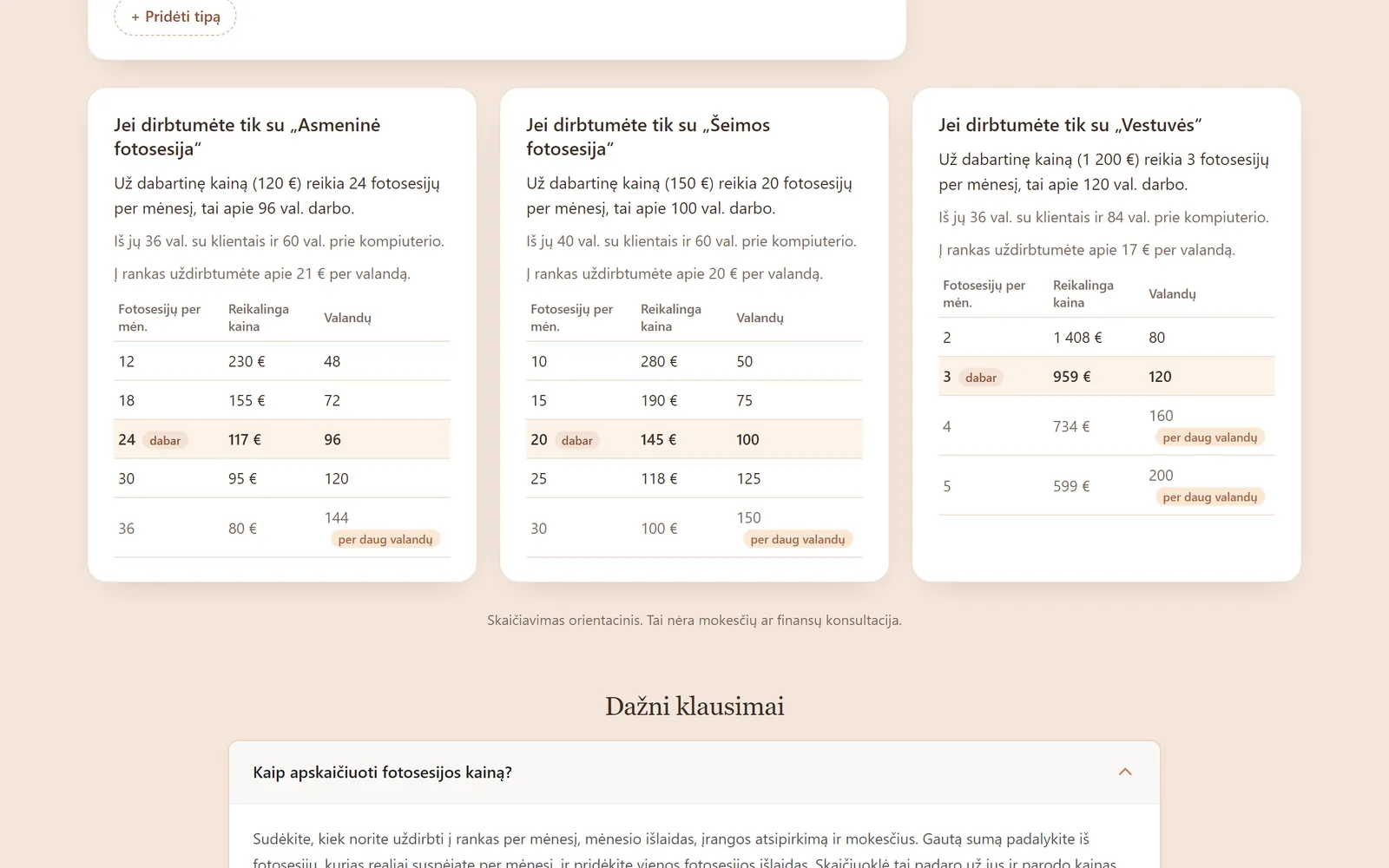
Now compare a common beginner price of €120 per session. To reach €2,490 you would need 21 sessions a month, which is about 157 hours of session work alone. That is a full working month with no time left for marketing, learning or rest, and it explains why so many photographers burn out in their second year.
Seasonality
Most photographers in Europe are busiest from May to September and quiet in winter, so it is more honest to calculate per year. You need €2,490 × 12 = €29,880 a year. If you shoot 90 sessions a year, each one has to cost around €330, not €250. That number is usually the biggest surprise.
You can run the whole calculation with your own hours, costs, gear and tax rate in the free photography pricing calculator. It shows how many sessions you need at your current price and what each session type should cost. Everything is calculated in your browser and nothing is sent anywhere.

The same maths for weddings
The logic for weddings is identical, just with more hours. Say meeting the couple and planning take 3 hours, shooting 10, travel 2, culling 6, editing 22, and gallery, selection and delivery another 2. That is 45 hours.
In the example above each hour needs to bring in about €33 (€2,490 ÷ 75 hours). So a wedding should cost 45 × €33, roughly €1,485, before a second shooter, an album or a hotel for a distant venue. If your wedding package is €700, you are working for about €15.60 an hour before costs and tax.
That does not mean you have to double your price tomorrow. It does show what every extra hour of editing costs you, and sometimes a better preset and a faster workflow do more than a price rise.
Turning the number into packages
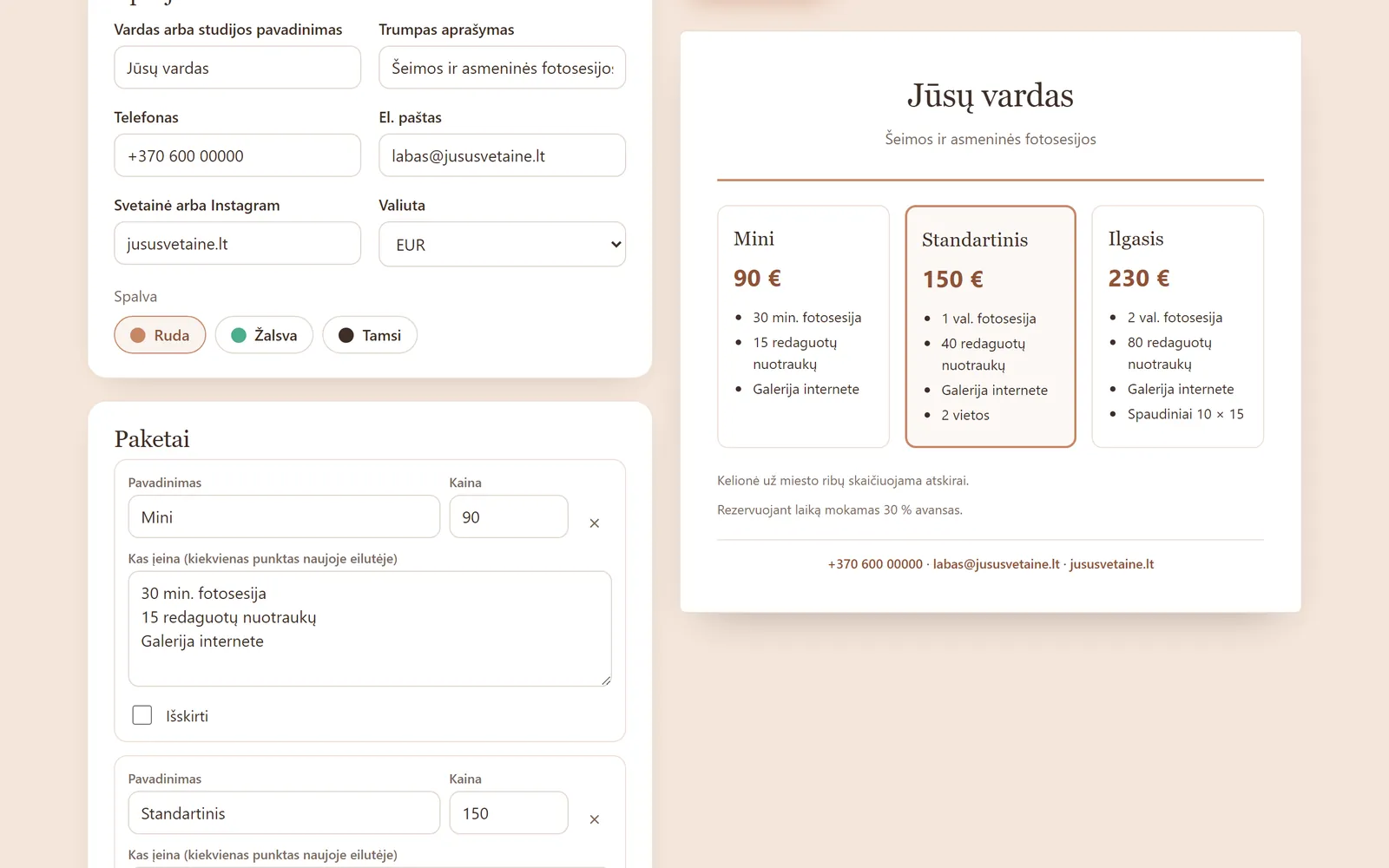
The number you calculated is your floor, not your price list. Clients find it easier to choose between two or three packages than to accept one price:
- a small package just above your floor, for example one hour and 20 photos;
- a middle package, the one you want most people to pick: 90 minutes and 35 photos;
- a large package with more time, more photos or a print.
Spell out what each package includes: hours, number of photos, delivery time, and the price of an extra photo. Avoid a bare "from €150". Clients who only see "from" tend to assume the real price is much higher and never write. The free photography price list template gives you a ready layout you can download as a PDF.
Take a deposit
Ask for a 20 to 30% deposit when the client secures the date, especially for weddings. A cancelled Saturday in May is a day you will not sell to anyone else. Put the deposit terms in your contract.
When to raise your prices
The signs are familiar: your calendar is full two months ahead, nobody negotiates, and editing keeps slipping. Raise prices by 10 to 15% for new clients and honour the agreed price for anyone who has already paid a deposit. You will lose a few price-driven clients, but you will work the same hours for more money.
Redo the calculation at least once a year. Costs rise, gear ages and tax rules change. It takes fifteen minutes, and afterwards it is much easier to explain to a client why your session costs what it does.
Sources (checked November 2026): the example uses Lithuanian self-employed contributions (Sodra, 2026). Rates differ by country and change every year.